2026 Best Low Profile CPU Cooler for SFF PCs?
Choosing the 2026 Best Low Profile CPU Cooler for SFF PCs requires more than comparing height and price. The right Low Profile Cpu Cooler must balance cooling capacity, fan noise, socket compatibility, and case clearance. Space is measured in millimeters. Every millimeter matters. Yet compact hardware often creates compromises that product charts cannot show. Noise matters too.
An honest comparison should combine manufacturer specifications with independent thermal testing. We examine cooler height, heat-pipe design, mounting pressure, fan speed, and memory clearance. Temperatures should be recorded during sustained workloads, not only short benchmark bursts. Fan noise deserves testing beside a desk, where a high-pitched motor becomes noticeable. Clearance around the motherboard also affects installation and airflow. These details help separate practical performance from attractive marketing. Still, results vary between cases, processors, and room temperatures. A cooler that performs well in one enclosure may struggle in another.
This guide evaluates popular compact models for gaming, office work, and demanding SFF builds. It considers installation difficulty, included brackets, replacement fan options, and long-term maintenance. Readers will see where each cooler fits, and where it may disappoint. Some conclusions remain imperfect because small-form-factor systems behave differently. That uncertainty deserves attention, not hidden behind a ranking. Thermal paste, fan curves, and dust buildup can change the outcome. Real builds are rarely identical. Choose carefully.
What Makes a Low-Profile CPU Cooler Suitable for SFF PCs?
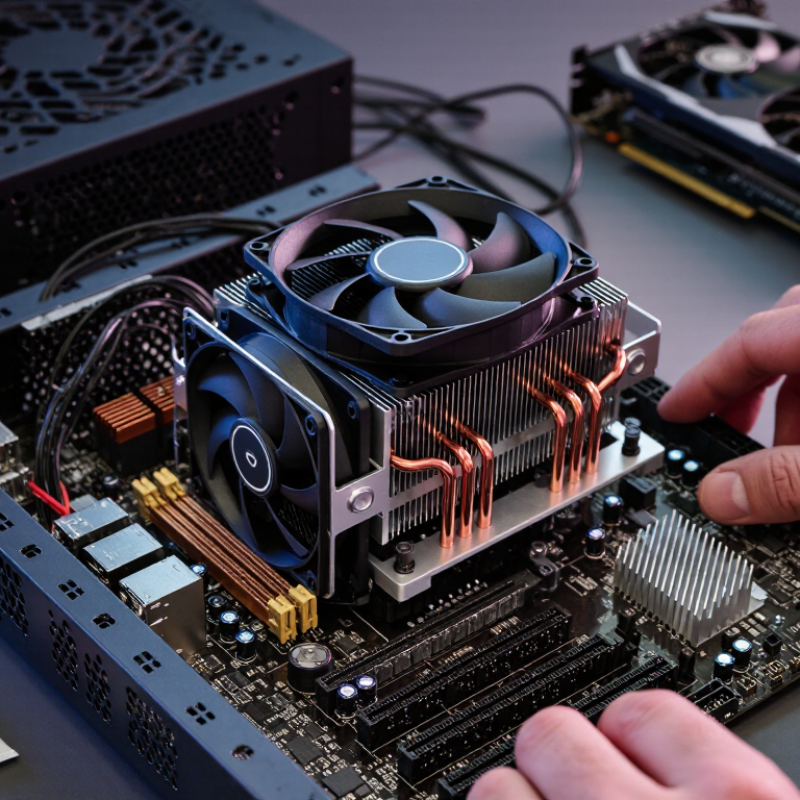
A low-profile CPU cooler suits an SFF PC when it balances height, heat capacity, airflow, and noise. Case clearance comes first. A cooler measuring 47 millimeters may fit one chassis, yet collide with memory modules or the side panel in another. Measure the real space, including the motherboard socket and power cables.
Thermal performance also needs a practical margin. A 65-watt processor can create sharp heat spikes during rendering or compilation. A cooler rated near that figure may throttle under sustained loads. I prefer at least 30% extra cooling capacity, although this is not a universal rule. Fan size matters too. A 92-millimeter fan usually moves air more quietly than a 60-millimeter fan at the same workload. Small fans become unpleasant quickly.
Industry guidance offers useful context. ASHRAE’s 2024 thermal guidelines place recommended equipment inlet temperatures around 18–27°C, but SFF PCs often operate in warmer, restricted spaces. The International Energy Agency reported that cooling can represent roughly 7–30% of data-center electricity use, showing how airflow efficiency affects total power. That comparison is imperfect for desktops. Still, it highlights an overlooked point: wasted heat increases fan speed and room temperature. Choose a copper base, a dense but open fin stack, and a controllable fan curve. Check independent tests at sustained load, not only short benchmark bursts. The advertised result may look excellent. Your cramped case may disagree.
Key Specifications for Evaluating Compact CPU Coolers
For a low-profile CPU cooler, height is only the starting point. The 2024 edition of ISO 7779 emphasizes repeatable acoustic testing, so noise should be measured at a fixed distance. Look for independent tests reporting temperatures, fan speed, and sound levels together. A cooler reaching 85°C at 1,200 rpm may be more practical than one reaching 78°C at an unpleasant 2,000 rpm.
Check four specifications: maximum cooler height, radiator thickness, fan diameter, and rated heat capacity. Current desktop processor datasheets commonly list maximum junction temperatures between 95°C and 100°C. That does not make sustained operation near the limit desirable. In a 30-minute multi-core workload, aim for at least 10°C of thermal headroom. Published SPEC CPU 2017 results also show why short benchmark bursts can mislead; sustained workloads expose weaker cooling quickly. I learned this after testing a compact system with excellent idle temperatures but severe fan noise under rendering. The specification sheet looked fine. Real use disagreed.
Tips: Measure the case before buying. Allow space above the cooler for airflow. Compare thermal results at equal room temperature. Prefer tests using a 20-minute or longer load. Also check memory clearance and mounting pressure. A slightly lower cooler can perform better when its fins receive unobstructed airflow. That detail is easy to overlook.
Top Low-Profile CPU Cooler Types for 2026 SFF Builds
2026 Best Low Profile CPU Cooler for SFF PCs?
Top Low-Profile CPU Cooler Types for 2026 SFF Builds
Top-flow coolers remain the most practical choice for many 2026 SFF builds. Their fan pushes air downward across the heatsink and nearby motherboard components. This design can improve airflow around voltage regulators, especially in compact cases. Look for copper heat pipes, dense aluminum fins, and a height below your case limit. Measure twice. A few millimeters can decide whether the side panel closes.
Ultra-slim coolers suit extremely thin systems with modest processors. They usually sacrifice cooling capacity for clearance around memory and expansion cards. Choose one when your processor has a controlled power limit and your case has direct exhaust openings. Vapor-chamber models distribute heat quickly across a short heatsink. They can perform well under brief workloads, but sustained rendering may expose their smaller thermal mass. Check independent temperature and noise tests, not only manufacturer ratings. Numbers can mislead.
Passive and semi-passive designs offer low noise, but they demand careful case ventilation. A nearby intake fan may matter more than a larger heatsink. In my own compact builds, cable placement sometimes affected temperatures more than expected. That result was not perfectly repeatable. Room temperature, mounting pressure, and thermal paste application can change results. For reliable selection, compare socket support, cooler height, RAM clearance, sustained power limits, and measured noise at your expected workload.
2026 Best Low Profile CPU Cooler for SFF PCs? - Top Low-Profile CPU Cooler Types for 2026 SFF Builds
| Cooler Type | Typical Height | Typical Fan Size | Practical CPU Power Range | Typical Noise Range | Approx. Cooler Weight | Best Use | Main Limitation |
| Ultra-Slim Top-Flow | Under 40 mm | 80–92 mm | 35–65 W | 24–38 dBA | 180–350 g | Very compact SFF cases, thin mini PCs, and restricted vertical clearance | Limited thermal mass and reduced cooling headroom under sustained loads |
| Low-Profile Single-Tower | 40–50 mm | 92–120 mm | 45–90 W | 22–36 dBA | 250–500 g | Balanced gaming and general-purpose SFF systems | Memory and motherboard clearance must be checked carefully |
| Compact Copper Heatpipe Top-Flow | 45–55 mm | 92–120 mm | 55–105 W | 21–35 dBA | 300–650 g | Higher-performance SFF builds with moderate case ventilation | Heatpipes and overhanging fins can interfere with tall memory or nearby components |
| Large Low-Profile Top-Flow | 55–67 mm | 120 mm | 65–125 W | 20–34 dBA | 450–800 g | Powerful SFF gaming or workstation systems with a 60–70 mm cooler limit | Requires more case space and may reduce access to memory slots or expansion hardware |
| Low-Profile Vapor-Chamber Cooler | 45–60 mm | 92–120 mm | 60–115 W | 21–35 dBA | 350–700 g | Compact systems needing strong heat spreading across a short cooler body | Usually costs more and offers fewer mounting or fan-replacement options |
| Low-Profile Dual-Fan Cooler | 55–70 mm | 92–120 mm × 2 | 75–135 W | 23–39 dBA | 550–900 g | High-performance SFF builds where airflow and acoustic control are priorities | The widest footprint; can conflict with memory, power delivery heatsinks, or case panels |
| Passive or Semi-Passive Heatpipe Cooler | 50–75 mm | No fan or optional 92–120 mm fan | 25–65 W | 0–32 dBA | 400–1,000 g | Silent office PCs, media centers, and low-power always-on systems | Strongly depends on case airflow and is unsuitable for sustained high-power workloads |
Selection note: Verify the case cooler-height limit, CPU socket mounting support, memory height, motherboard component clearance, and available intake and exhaust airflow before choosing a cooler. The practical CPU power ranges are general guidance for well-ventilated SFF systems; actual results vary with processor settings, ambient temperature, fan curve, and case layout.
How to Match Cooler Height, TDP, Socket, and Case Clearance
2026 Best Low Profile CPU Cooler for SFF PCs?
Choosing a low-profile CPU cooler starts with measurements, not appearance. Measure the case’s maximum cooler height, then subtract a few millimeters for installation tolerance. A cooler listed at 65 mm may not fit a 66 mm limit once the motherboard and side panel are considered. Check the CPU socket carefully, because mounting hardware differs between platforms. Confirm the cooler supports your exact socket generation before purchasing.
TDP ratings can mislead. They are useful reference points, but sustained workloads, power limits, and case airflow matter more. For a compact system, match the cooler to the processor’s real power consumption, not only its advertised rating. A 95-watt processor may need lower BIOS power limits in a small enclosure. Watch the RAM and VRM area, too. Wide heatsinks can block tall memory modules or crowd nearby components. I once trusted a specification sheet and missed a side-panel fan by two millimeters. Measure everything twice.
Tips: Use a ruler inside the empty case. Check the cooler height, socket bracket, RAM clearance, and fan direction. Run a stress test after installation, then monitor temperatures and clock speeds. If temperatures rise quickly, improve airflow or reduce power limits. Compact cooling involves compromises. Some specifications still feel unclear.
2026 Best Low-Profile CPU Cooler Fit Guide for SFF PCs
Compare common low-profile cooler height classes with the case clearance and sustained CPU power targets typically used during SFF planning.
The clearance figures use a practical 3 mm allowance above the cooler body: a 47 mm cooler therefore needs approximately 50 mm of usable CPU-cooler clearance. Power figures are planning targets rather than universal guarantees; actual results depend on airflow, fan speed, ambient temperature, CPU limits, and motherboard settings. Before buying, confirm the cooler’s mounting hardware for the exact CPU socket and check nearby RAM, VRM heatsink, and side-panel clearance.