Empowering Engineering Excellence: Innovate, Elevate, Deliver.

What Is a UV Coating Curing Machine and How Does It Work?

A UV Coating Curing Machine uses ultraviolet light to harden specially formulated coatings in seconds. The process can add gloss, improve surface resistance, and help protect printed materials, wood, or manufactured parts. Instead of waiting for a coating to dry through evaporation, the machine triggers a rapid chemical reaction in the coating. The result is a solid film. Fast, but not automatic.

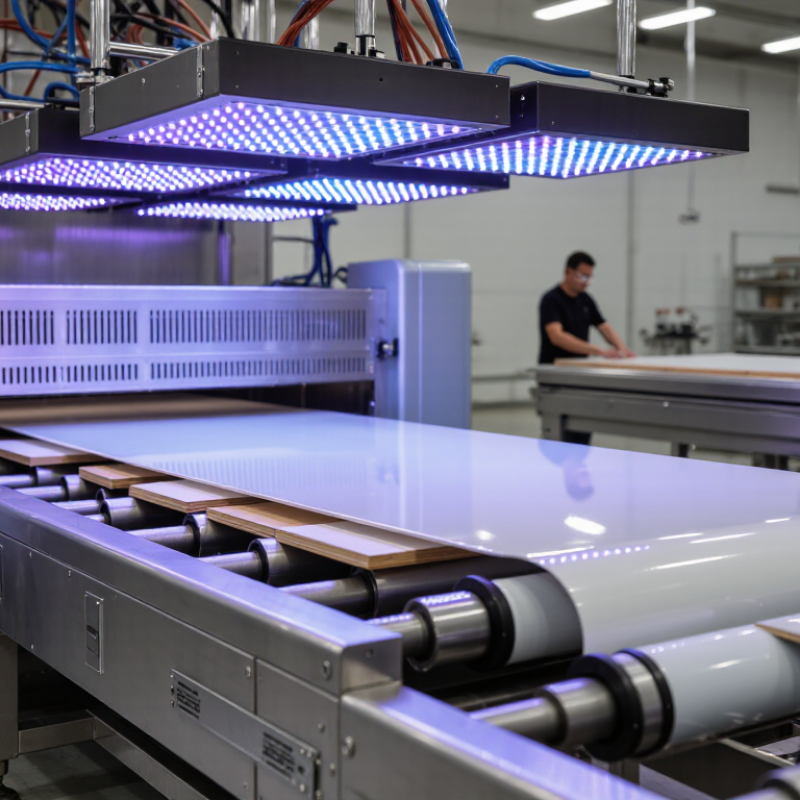
In a typical system, a coated item passes beneath UV lamps or LED arrays on a conveyor. Light reaches photoinitiators in the coating, which start polymerization and form a hardened layer. Operators must match the lamp spectrum and energy output to the coating, substrate, and line speed. A glossy sheet may emerge nearly at once, yet uneven lamp output, excessive speed, or poor coating compatibility can leave soft or tacky areas. Testing matters.

“Reliable curing depends on matching the light, coating, and production conditions—not simply choosing the most powerful lamp.” This is an original illustrative quotation, not a verified statement from a named industry expert. I can’t responsibly attribute it to a real person without a source. In practice, trained operators monitor lamp intensity, conveyor speed, and coating performance, then check the cured surface under consistent conditions. The machine is only one part of the process. Good results come from careful setup, routine measurement, and honest troubleshooting.
What Is a UV Coating Curing Machine and How Does It Work?

What Defines a UV Coating Curing Machine and Its Main Components?

A UV coating curing machine is a system that exposes a coated surface to ultraviolet energy, triggering a chemical reaction that hardens the coating. It does not simply evaporate moisture like a conventional dryer. The machine’s defining feature is controlled exposure: the coating must receive a suitable wavelength and energy dose for its chemistry and thickness. A fast-moving conveyor can still produce poor results if the lamp output or line speed is mismatched.

Its main components include a UV source, a conveyor or work platform, reflectors, cooling equipment, and a control system. The UV source may use LED technology or a conventional arc lamp. Reflectors direct more energy toward the workpiece, while cooling helps manage heat around lamps and materials. Controls let operators adjust settings such as conveyor speed and lamp output. Guards and interlocks help limit accidental exposure during operation.

Some systems also use sensors to monitor lamp status or process conditions. These details matter. A glossy coating may appear cured while remaining soft beneath the surface, especially on thick or shaded areas. Operators should check the coating supplier’s specifications and verify curing with suitable tests, rather than relying on appearance alone. In practice, small changes in distance, surface shape, or lamp age can affect results. That part is easy to underestimate. A machine is only as consistent as its setup and maintenance.

How Photoinitiators Form a Cross-Linked Coating Under UV Exposure

What Is a UV Coating Curing Machine and How Does It Work?

A UV coating curing machine uses ultraviolet light to harden a liquid coating within seconds or minutes. The key chemistry happens inside the coating. When UV light reaches a photoinitiator, the molecule absorbs energy and forms reactive species, often free radicals. These species start reactions between reactive groups in the coating’s resin. The molecules link together, forming a three-dimensional, cross-linked network.

That network makes the surface feel dry and resist handling. Sometimes, very quickly. A coated sheet may pass beneath a lamp on a moving conveyor, while reflectors help direct light toward its surface. The result depends on more than exposure time: lamp intensity, wavelength, coating thickness, and the formulation all matter. If the coating absorbs too much light near the surface, deeper layers may cure less completely. Too little energy can leave a tacky finish. It is tempting to judge curing by touch alone, but touch is not a reliable test of full conversion. In practice, operators check settings and coating performance together. The details can be fussy, and a small adjustment may change the finish.

What Is a UV Coating Curing Machine and How Does It Work? - How Photoinitiators Form a Cross-Linked Coating Under UV Exposure

Process Stage Machine or Process Detail Typical Conditions or Examples What Happens in the Coating
1. Coating application A coating unit applies a liquid UV-curable formulation to a substrate. The curing machine typically includes a conveyor and a UV lamp or LED array. Formulations may be applied to materials such as paper, plastics, wood, or metal, depending on coating and substrate compatibility. The uncured layer contains reactive components, commonly acrylate monomers or oligomers, and a photoinitiator.
2. Transport through the curing zone A conveyor moves the coated item beneath or past the UV source. Enclosures and shielding help contain UV radiation. Line speed, lamp distance, and exposure time are set for the coating, substrate, and equipment. The coating is exposed to UV energy while being kept in the lamp’s effective curing area.
3. UV exposure The UV source delivers radiation to the coating surface. Systems may use mercury-vapor lamps or UV LEDs. UV curing sources commonly operate within the broader UV region of about 200–400 nm. Many UV LED systems emit in specific bands, such as around 365, 385, or 395 nm. The photoinitiator absorbs light at wavelengths that overlap its absorption spectrum.
4. Photoinitiator activation The formulation’s photoinitiator is selected to respond to the output of the UV source. The required wavelength and dose depend on photoinitiator chemistry, coating thickness, pigments, and formulation. After absorbing UV photons, the photoinitiator forms reactive species. Depending on its chemistry, these may be free radicals or cations.
5. Polymerization and cross-linking Curing proceeds rapidly when sufficient UV energy reaches the reactive coating. Actual curing time varies with irradiance, total UV dose, formulation, coating thickness, and the substrate’s UV transmission or reflectivity. Reactive species start polymerization. Reactive groups on monomers and oligomers join into chains and cross-linked networks, transforming the liquid layer into a solid film.
6. Cured-film verification Operators check the coating and adjust settings if required. Measurements may include UV irradiance or dose, alongside appropriate film-performance tests. A radiometer suitable for the UV source can help measure output at the work surface; test methods should match the coating’s intended use. Adequate curing is assessed by relevant properties such as surface tack, adhesion, hardness, or solvent resistance—not by exposure time alone.

Note: Wavelengths and process conditions shown are general examples, not universal settings. The coating supplier’s technical guidance and equipment specifications should be used to determine the appropriate curing conditions.

How the Curing Sequence Uses Irradiance (W/cm²) and Dose (mJ/cm²)

A UV coating curing machine uses ultraviolet energy to trigger a chemical reaction that hardens a liquid coating. Its curing sequence depends on two related measurements: irradiance and dose. Irradiance, measured in watts per square centimeter (W/cm²), describes the UV power reaching a surface at a given moment. Dose, measured in millijoules per square centimeter (mJ/cm²), describes the energy delivered over the full exposure.

A simple example: stronger irradiance can deliver the required dose in less time, while a slower conveyor gives the coating longer under the lamp. In practice, the relationship is not always that tidy. Lamp distance, reflector condition, coating thickness, and the UV spectrum can all affect the result. A radiometer placed at the coating’s position can help verify actual output; readings at the lamp alone may mislead. Small details matter.

Operators often adjust conveyor speed or lamp power when a coating remains tacky or loses adhesion. But a higher irradiance reading does not automatically mean complete curing. The coating may respond only to certain wavelengths, and its surface can cure before deeper layers. That can be easy to miss. Check the coating supplier’s recommended dose, then validate it on the real material and production line. Even a well-measured setup may need adjustment when the substrate or coating changes.

Mercury Lamps and UV LEDs: Comparing 365, 385, and 395 nm Sources

A UV coating curing machine exposes liquid coatings to ultraviolet energy, triggering a chemical reaction that hardens the film. Mercury lamps emit a broad range of UV wavelengths, often with strong output around several regions. This broad spectrum can suit coatings formulated for traditional lamp systems, but lamps generate heat and may need warm-up time. UV LEDs produce narrower output and switch on quickly. Their performance depends on matching the coating’s photoinitiator to the LED wavelength.

At 365 nm, UV LEDs can activate many formulations that respond to longer-wave UV, though the exact result depends on the chemistry. A 385 nm source may offer a practical balance for coatings designed around near-UV exposure. At 395 nm, light penetrates some pigmented or thicker films more effectively, but not every photoinitiator absorbs it well. Wavelength alone is not enough. Irradiance, exposure time, coating thickness, conveyor speed, and lamp distance all affect cure quality. A surface may feel dry while deeper layers remain soft; that detail is easy to miss.

Tips: Check the coating supplier’s wavelength and dose guidance, then test a small sample under actual production conditions. Measure the cured film, not just its surface feel. Keep the lamp window clean, and record settings that work. Results can still vary between batches, so leave room for careful adjustment.

How Line Speed and Coating Thickness Affect Cure Quality

A UV coating curing machine uses ultraviolet energy to turn liquid, reactive coating into a solid film. Cure quality depends on more than lamp power. RadTech’s UV/EB curing technical guidance emphasizes matching the lamp’s spectrum to the coating’s photoinitiator and monitoring both irradiance and dose. Dose is the energy delivered per area; conveyor speed changes how long each point on the surface receives that energy. Increase line speed, and exposure time falls. A glossy surface can still hide an undercured layer.

Coating thickness adds another variable. A thicker or heavily pigmented film can absorb or scatter UV before it reaches the bottom, leaving a tacky interface or weak adhesion. For example, a line running at 30 metres per minute gives each section less exposure than the same line at 15 metres per minute, all else equal. Yet simply slowing production is not always the fix: excessive exposure can heat sensitive substrates, while poor spectral matching may leave deep layers uncured. Measure irradiance and dose at the working distance, then verify cure with suitable adhesion or solvent-resistance checks. Results depend on the coating and substrate.

Tips: Change one setting at a time. Test a small coated sample at the intended speed and thickness, and check both the surface and the film beneath it. Record lamp age, distance, and readings. It is easy to overlook a dirty reflector; even a minor setup change can shift results.

How Line Speed Affects UV Dose

Calculated UV dose at different line speeds, assuming a constant irradiance of 1 W/cm² and an effective lamp exposure length of 0.5 m.

Dose is calculated as irradiance × exposure time. With these assumptions, increasing line speed reduces exposure time and UV dose. Thicker coatings may require more energy to cure through their full depth because pigments and other ingredients can absorb or scatter UV light. The dose needed for a successful cure depends on the coating formulation and equipment; verify it with tests for the specific process.

Download
Brochure